
Super Smash Bros. is a series of fighting games involving characters from Nintendo’s established franchises battling it out. The original game was developed on a very low budget expected to go nowhere and yet has become one of Nintendo’s best selling series. It was Super Smash Bros. Melee not The Legend of Zelda: The Wind Waker or Super Mario Sunshine that was the most successful game on the Gamecube. Now, just days away from the third installment in the series, and arguably the most anticipated Wii game touching down in Australia it looks as if it’s dominance will continue.
Creation
Titled ”Dragon King: The Fighting Game” Super Smash Bros. began as a prototype created by Masahiro Sakurai and Satoru Iwata during their spare time in 1998 and did not include any Nintendo characters. Deciding that the game needed a new ‘atmosphere’ in order to be a successful fighter on home consoles, Sakurai had the idea of including Nintendo characters from various franchises. The game was granted a very small budget and was released in Japan only, where it sold several million copies. After this unexpected but much welcomed success the game was released worldwide and spawned two sequels. Super Smash Bros. Melee was given a much larger budget and development team which showed in the high levels of critical acclaim the title received for addressing the issued raised in the first title.

The first title was developed by Hal Laboratory, under former director Satoru Iwata and published by Nintendo. Iwata then went on to become president of Nintendo (Japan) and continued to have a strong involvement with the series. Melee was once again developed by Hal Laboratory and published by Nintendo. Brawl however was developed by a collaboration of second and third party developers including Sora, a company created by Smash Bros founder and former Hal Laboratory employee Masahiro Sakurai, this kept the original designers Sakurai and Iwata together for the third installment in the series. Nintendo opened a new office in Tokyo just for it's production so the developers could work together under direction from Sakurai.
Gameplay
The Super Smash Bros. series is unlike a conventional fighting game where players must diminish their opponents life bar. In Smash Bros. inflicting maximum damage does not guarantee victory, rather players must attempt to knock their foes off the stage, as they take damage from being hit they will become more likely to fly off the stage. Once knocked out of the open arena, players may have the opportunity to recover, by jumping back onto the platform. Some characters, such as the lighter fighters, have a longer jump and therefore a higher chance of recovering, while the heavier characters may have lower chance of making the jump they are harder to knock off of the stage.

Multiplayer
Perhaps the greatest feature of the Smash Bros games is not only being able to battle it out against other Nintendo characters but to do so in intense 4 player action packed battles with friends for ultimate bragging rights. The specific rules are determined prior to the start of the match and the game can be set up to determine a winner in variety of different ways, the most popular being those introduced in the original title as a stock or timed battles. Stock gives players a certain amount of 'lives', the last standing player after all other contestants lose their stock is declared the winner. Players can choose any of the Nintendo Characters or stages available as long as they have been unlocked. To unlock these players must accomplish many different tasks within the game, much of which must be done through completing the single player quest.
Single Player
The first two titles are considered to be 'multiplayer' games due to the extremely strong multiplayer compared to the rather poor single player. The N64 title offered 'classic mode' as it would become known in sequels. Players choose a character and fight a series of opponents which would always be in the same order. Two single player mini-games, "Break the Targets" and "Board the Platforms" are including where you must break the targets and board the platforms respectively within a time limit. Melee saw the return of 'classic mode' but also introduced 'adventure mode' allowing players to move along in a side-scrolling world in between battles. While the series will never been known for it's single player, Nintendo attempted to give a meaningful solo experience in SSBB. Including all the past game modes with extra mini games, Brawl also includes a single player adventure, with a plot!

Online
Super Smash Bros. Brawl is the first title in the series to take advantage of the world of online gaming using Nintendo's Wi-Fi Connection service. Players can play one of Nintendo's finest multiplayer games with distant opponents, no longer are gamers restricted to playing against the same family members or AI you can play anyone worldwide. Online games can be played with registered friends, through the exchange of friendcodes or against any randomly selected opponents. Against friends players nicknames are displayed above their character, they are also able to communicate with up to four different preset phrases on screen which will appear above the fighter in speech bubbles. If 'Allow Spectators" has been enabled the match can be viewed by an audience who are able to bet on the outcome with coins that they have earned. Snapshots and video footage can be taken in some game modes and sent to friends via Wi-Fi Connection.
The Games
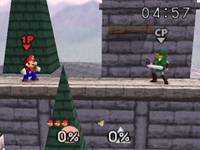
Release:
Jap: January 21, 1999
US: April 26, 1999
AUS/EU: November 19, 1999
Super Smash Bros. received mostly positive reviews with much praise for the multiplayer, although many gamers felt let down by the limited single player mode. The title sold over 3.7 million copies worldwide, 2.9 million of those coming from the US where the game was never intended to see the light of day.
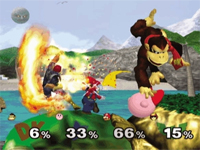
Release:
Jap: November 21, 2001
US: December 3, 2001
EU: May 24, 2002
Aus: May 31, 2002
Super Smash Bros. Melee features 26 characters, 15 of which are available out of the box which has more than doubled that of the original title, as the 12 veteran fighters return and are joined by 14 others. The initial fighters available are Mario, Pikachu, Bowser, Princess Peach, Yoshi, Donkey Kong, Captain Falcon, Fox McCloud, Ness, Ice Climbers, Kirby, Samus Aran, Link, Princess Zelda and her alternate form Shiek. Unlockable characters include Luigi, Jigglypuff, Mr. Game and Watch, Prince Marth, Mewtwo. The remaining 6 characters are considered 'clone' characters as they mimic the moves of their counterparts, they are Dr. Mario, Falco, Ganondorf, Pichu, Roy and Young Link.
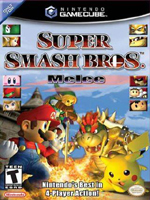
Super Smash Bros. Melee received positive reviews, with many critics agreeing that it went a long way in improving Super Smash Bros. The visuals and music were praised for as one of the best sounding and looking games on the Gamecube(at it's time). Melee has sold over 7 million copies worldwide and as of the 10th of March 2008 it is the best selling Gamecube game of all time.
Release:
Jap: January 31, 2008
US: March 9, 2008
Aus: June 26, 2008
EU: June 27, 2008
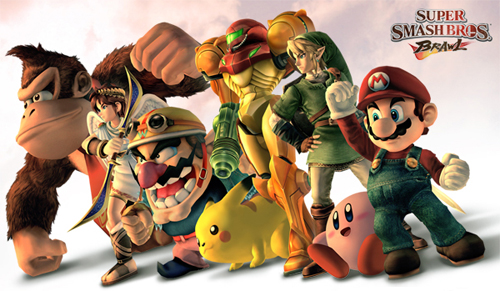
Players have the option of controlling the game with the Wii Remote and Nunchuck together, the Wii Remote on its side, the Gamecube Controller or the Classic Controller. The series signature mutliplayer mode returns, redefined with the inclusion of "Final Smash" moves, these are much more powerful than regular attacks and are available due to temporary transformations. Other forms of multiplayer are available in 'group mode', Special Melee returns as Special Brawl, while the previous title only allowed for one customization such as 'giant' mode or 'invisible' mode Brawl allows a combination of these. Tourney mode returns to allow tournaments between human and AI fighters, while 'rotation' has also been included and allows up to 16 players to compete by switching out winners and losers after each round.
Super Smash Bros. Brawl received critical acclaim, including a perfect score from Japanese game magazine Famitsu. The unexpected depth of the single player and the unpredictability of the final smash were praised as well as the online component of the game. Brawl has sold 4.85 million copies worldwide as of March 31 2008, 500,000 units were sold in Japan on it's first day on sale.
Characters

42 Characters have taken to the area in the 3 Super Smash Bros games to date, 12 in the original, raised to 26 in Melee and then went up to 35 in Super Smash Bros Brawl. All playable characters that have appeared in a Super Smash Bros. game are listed below, in alphabetical order. The list details the series that the character originates from and which of the 3 games the are featured in.
Character | Game Series | Super Smash Bros. | Super Smash Bros. Melee | Super Smash Bros. Brawl |
|---|---|---|---|---|
| Bowser | Mario Bros. | NO | YES | YES |
| Captain Falcon | F-Zero | YES | YES | YES |
| Diddy Kong | Donkey Kong | NO | NO | YES |
| Donkey Kong | Donkey Kong | YES | YES | YES |
| Dr.Mario | Mario Bros. | NO | YES | NO |
| Falco | Star Fox | NO | YES | YES |
| Fox | Star Fox | YES | YES | YES |
| Ganondorf | Zelda | NO | YES | YES |
| Ice Climbers | Ice Climbers | NO | YES | YES |
| Ike | Fire Emblem | NO | NO | YES |
| Jigglypuff | Pokemon | YES | YES | YES |
| King Dedude | Kirby | NO | NO | YES |
| Kirby | Kirby | YES | YES | YES |
| Link | Zelda | YES | YES | YES |
| Lacario | Pokemon | NO | NO | YES |
| Lucas | Earthbound | NO | NO | YES |
| Luigi | Mario Bros. | YES | YES | YES |
| Mario | Mario Bros. | YES | YES | YES |
| Marth | Fire Emblem | NO | YES | YES |
| Meta Knight | Kirby | NO | NO | YES |
| Mewtwo | Pokemon | NO | YES | NO |
| Mr.Game & Watch | Game & Watch | NO | YES | YES |
| Ness | Earthbound | YES | YES | YES |
| Olimar | Pikmin | NO | NO | YES |
| Peach | Mario Bros. | NO | YES | YES |
| Pichu | Pokemon | NO | YES | NO |
| Pikachu | Pokemon | YES | YES | YES |
| Pit | Kid Icaris | NO | NO | YES |
| Pokemon Trainer | Pokemon | NO | NO | YES |
| R.O.B. | R.O.B. | NO | NO | YES |
| Roy | Fire Emblem | NO | YES | NO |
| Samus | Metroid | YES | YES | YES |
| Shiek | Legend of Zelda | NO | YES | YES |
| Snake | Metal Gear | NO | NO | YES |
| Sonic | Sonic the Hedgehog | NO | NO | YES |
| Toon Link | Zelda | NO | NO | YES |
| Wario | Wario | NO | NO | YES |
| Wolf | Star Fox | NO | NO | YES |
| Yoshi | Mario / Yoshi | YES | YES | YES |
| Young Link | Zelda | NO | YES | NO |
| Zelda | Zelda | NO | YES | YES |
| Zero Suit Samus | Metroid | NO | NO | YES |
Points of Interest
- Famitsu Magazine: Super Smash Bros. Brawl - perfect 40/40
- Super Smash Brothers Melee Best Selling Gamecube Game - 7 Million Copies WorldWide
- Super Smash Bros. Brawl fastest selling Nintendo game
- Super Smash Bros. Brawl - 1.4 Million US sales in first week
- Famitsu Magazine: Super Smash Bros. Melee - 37/40
- 2000 AIAS - Game Design - The Legend of Zelda: Majora's Mask
- 36 Composers provided music for Brawl

No comments:
Post a Comment